

01

Broad-based enablement
A four-person team scales AI across 900 employees by organizing self-help instead of building solutions. The decisive lever remains visible buy-in from leadership.

Monthly thinking room
Where does free experimentation with AI end, and where does regulated operation begin? This edition shows how companies select AI tools, give agents permissions and independent review, and take employees' fears seriously.

1 conversation added · none removed
Added
9 unchanged · 1 sharpened
All supporting conversations in this edition
All supporting conversations in this edition
All supporting conversations in this edition
All supporting conversations in this edition
All supporting conversations in this edition
All supporting conversations in this edition
All supporting conversations in this edition
All supporting conversations in this edition
All supporting conversations in this edition
KPMG does not explain the value contribution with a usage rate of around 90 percent. Instead, the company uses interaction behavior to determine how mature individual employees' AI use is, identifies characteristics such as ambition, thinking before prompting and delegation, and derives buddy pairings as well as changes to learning offerings, hiring practices and performance evaluation from this.
View finding →All supporting conversations in this edition
Unchanged: the same five podcast episodes in the same order as in version 1.
Compared with V1 · 03 Aug 2026. Changes are documented in this edition; the full previous edition is not available.
The curator’s table
Selected conversations to start with, including context and their most relevant insights.

Broad-based enablement
A four-person team scales AI across 900 employees by organizing self-help instead of building solutions. The decisive lever remains visible buy-in from leadership.

AI without starting over
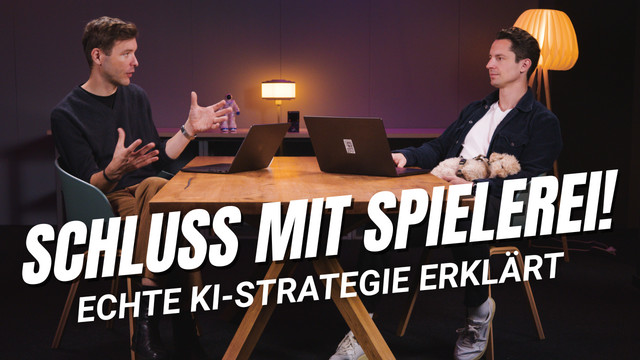
AI without starting over: first understand the existing landscape that has grown over time, then introduce AI in a structured way. The middle path between AI paralysis and decentralized sprawl makes corporate knowledge transparent.
Strategy before tools
The notorious 95 percent failure rate is methodologically questionable. Anyone who wants real transformation follows a five-stage plan and treats AI as a question of culture, not technology.

Adoption is a matter for the top
Stefanie Polster makes it clear: without steering from the executive board and top management, AI remains a playground. Real value creation only comes from an operating model instead of a tool zoo.
Pragmatic mid-sized companies
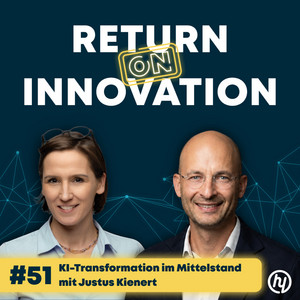
Pragmatic, purchased AI agents deliver value in weeks rather than months if the foundation and data are right and the transformation remains manageable through a Jira target model. A blueprint for mid-sized companies caught between academic platform debate and rapid experimentation.
What keeps recurring
Drawn from this edition’s conversations. Open a finding to read the context and explore the supporting episodes.

RAPS Group gives its field sales staff, who have ten to twelve customer appointments a day, a CRM-linked AI sales assistant that briefs them by phone call in the car before the appointment and records the report afterwards.
Verena Pausder dictates on the go between blocks of appointments with Whisper Flow, in which she has stored proper names and style preferences. Marie Kilg (Bayerischer Rundfunk) advises beginners to speak freely instead of typing prompts.
Deutsche Bahn tested the voice AI avatar Kiana at BER airport, where international travelers could ask about connections in their own language and buy a digital ticket directly.
Supported by these conversations
Ulrich Gerkmann-Bartels (enpit) reports that an agent wrote an API key into the repository despite precautions and only a second, independent agent found it. He calls for a guard that does not come from the same LLM vendor.
Strong DM has one LLM context write code from the specification and a second one, which knows only the specification and acceptance scenarios, test against it, so that agents cannot turn tests green with “return true”.
In a client project, MaibornWolff sends every pull request created with Claude Code through four review stages; Upvest adds a technically enforced human approval to AI reviews from Claude and Copilot.
Supported by these conversations
At Haufe Group, hard technical limits prevent payroll data from flowing into open systems; CIO Andreas Plaul allows employees to submit their own payslip to ChatGPT, but not those of other employees.
Upvest processes internal documents and personal data via Gemini in Google Workspace with zero data retention and a European data center, but handles coding work via Claude Code, because code is considered less sensitive.
IONOS lets teams working with public open-source code use US vendors freely, while customer-related or highly sensitive data stays in self-hosted IONOS models or under agreed data processing agreements.
Supported by these conversations
Marco Geuer places use cases in a matrix of risk and data availability: AI handles email drafts, a human stays in the loop for contract texts, and strategic decisions are always made by a human first.
Victoria Pelletier recommends that leaders work back from strategy to the task level rather than to job descriptions and use a superpower test to check which tasks stay with people even though they could be automated.
Because of its liability for the correct ticket, Deutsche Bahn also tested Kiana under noisy conditions, kept human guides on hand and plans a tiered escalation from self-service to the AI agent to the call center.
Supported by these conversations
After a free trial phase of around nine months, Cosnova rolled out ChatGPT Enterprise as its central AI tool for nearly 1,000 employees in eight global teams.
Jung von Matt first tries out all available AI tools and then approves only a fraction of them for work with client data, namely those whose vendors have signed security agreements with the agency.
Haufe Group usually offers two, at most three options per need, reviews new tools in an evaluation process with a fixed time window, and deliberately phases out less-used offerings.
Supported by these conversations
Antonio Krüger (DFKI) describes Germany's dual-track strategy: data centers of US hyperscalers are approved subject to review by the BSI, while Schwarz Group and Deutsche Telekom build their own computing infrastructure in parallel.
Marco Geuer uses the Organisational Resilience metric to measure how severe the business disruption would be if the AI capability failed tomorrow, and requires a vendor strategy, recovery tests and fallback models in every AI roadmap.
Dr. Sebastian Rosengrün (AI Impact Lab) advises CTOs at mid-sized companies to use open source and EU solutions, because staying with US technology is not an option in the medium term, even though 80 to 90 percent of mid-sized companies work in Microsoft environments.
Supported by these conversations
Max Schoening (Head of Product, Notion) replaces requirements documents with working prototypes (“Demos, not memos”), which shrinks the first 10 percent of a project to almost zero and lets several paths be explored in parallel by agents.
Markus Andrezak (Überprodukt) describes product managers who choose one of 9 variants built in parallel by Claude Code, and calls for them to talk to developers 5 to 10 times a day instead of signing off work in two-week sprints.
André Neubauer (Trusted Shops) describes how the bottleneck moves from writing code to code review to ideas, which is why a VP Engineering or CTO has to adapt roles and team structure along with it, and smaller teams are to be expected.
Supported by these conversations
Upvest uses an MCP gateway based on a Cloudflare product to tie tool access to Datadog, Linear or Slack to the company's own SSO, so that agents receive only the rights of the calling person and sessions expire daily.
Dr. Sebastian Kraska (IITR Datenschutz GmbH) recommends extending IT's existing permissions and role concept to agents such as Claude Code or Copilot Studio, so that they see only what the user is allowed to see.
According to Dr. Sebastian Wieczorek (CEO, Mantix), the agent in the Mantix assistant shares the session with the user, sees only that user's data and can only execute what the user could do through the interface anyway.
Supported by these conversations
Anthropic has encoded the working methods of its best account executives into five Claude skills such as Morning Briefing and Call Prep, which new reps receive as a sales plugin from day one.
Y Combinator gave an agent the transcript of an office hour in which partners commented on founders' two-sentence pitches in order to improve a skill, and new employees use an agent to call up a simulation of the best partners.
ÖBB Personenverkehr wants to secure the experiential knowledge of long-serving employees before they retire: they explain a case to younger colleagues, and the conversation is turned into structured knowledge through speech capture.
Supported by these conversations
According to Felix Schlenther, Zapier has defined four levels of AI use for every role, from “unacceptable”, which means removal from the role, to “transformative”, linked to upskilling, goals and incentives.
cosnova measures the AI maturity of each department in six dimensions with 40 to 50 items each, first as a self-assessment, then through the Gen AI team, and derives measures and time budgets from the discrepancies.
KPMG analyzed 1.4 million AI interactions over eight months because a usage rate of around 90 percent did not explain ROI, and realigned its learning offerings, hiring practices and performance evaluation according to the type of use.
Supported by these conversations
The complete collection
46 conversations, ordered from newest to oldest.

Your selection
Your selection from this thinking room is saved in this browser.
No saved episodes yet.
Browse the catalogue